Introduction
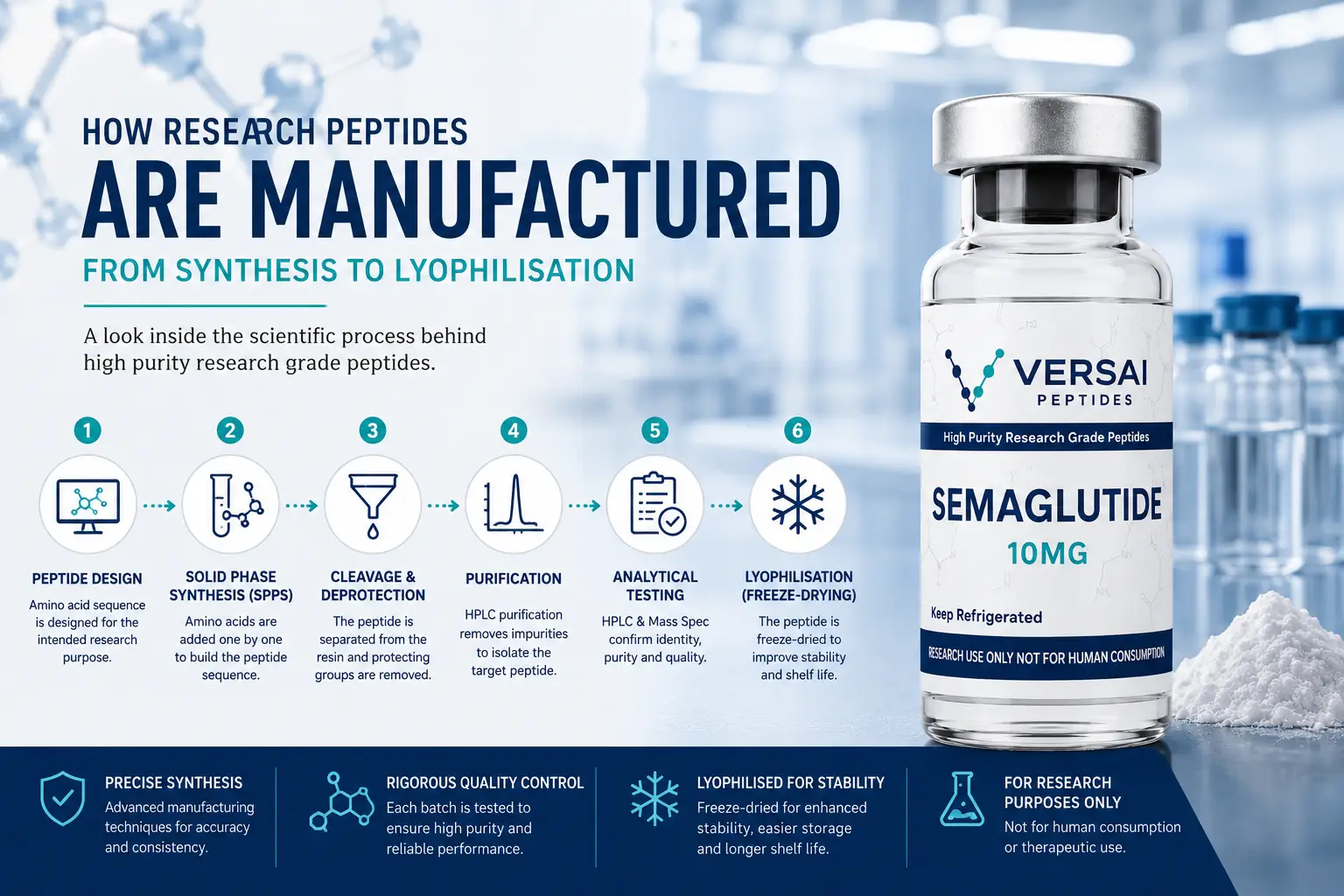
The quality of a research peptide begins long before it reaches a laboratory. Every peptide undergoes a series of carefully controlled manufacturing processes designed to produce a defined amino acid sequence suitable for scientific research.
Understanding how research peptides are manufactured can help researchers make informed purchasing decisions and appreciate the importance of quality control, purification, and proper handling.
In this guide, we explain the typical journey of a research peptide—from amino acid synthesis through purification, analytical testing, lyophilisation, packaging, and distribution.
Disclaimer: Products supplied by Versai Biotech Ltd are intended for laboratory research purposes only. They are not intended for human consumption, therapeutic use, veterinary use, diagnosis, treatment, or prevention of disease.
What Is Peptide Manufacturing?
Peptide manufacturing is the process of chemically assembling amino acids into a specific sequence. The resulting peptide is then purified, tested, freeze-dried, packaged, and prepared for laboratory use.
Each stage plays an important role in producing a research-grade material suitable for scientific investigation.
Step 1: Designing the Peptide Sequence
Every peptide begins with a defined amino acid sequence.
Researchers or manufacturers specify the exact order of amino acids required for a particular scientific purpose. Even a single amino acid difference can change the characteristics of a peptide, which is why precision is essential throughout the manufacturing process.
Step 2: Solid Phase Peptide Synthesis (SPPS)
The most widely used method for producing research peptides is Solid Phase Peptide Synthesis (SPPS).
During SPPS:
- Amino acids are added one at a time.
- Each addition is carefully controlled.
- Protective chemical groups help prevent unwanted reactions.
- The growing peptide chain remains attached to a solid support until synthesis is complete.
This technique allows manufacturers to build complex peptide sequences with a high level of precision.
Step 3: Cleavage and Deprotection
Once the peptide sequence has been assembled, it is separated from the solid support.
Protective groups that were used during synthesis are also removed, leaving the intended peptide available for further processing.
At this stage, the product is still considered crude and contains impurities that must be removed before it is suitable for laboratory research.
Step 4: Purification
Purification is one of the most important stages of peptide manufacturing.
The goal is to separate the target peptide from:
- Incomplete peptide chains
- Residual synthesis chemicals
- Unwanted by-products
- Other impurities generated during production
A commonly used purification technique is High-Performance Liquid Chromatography (HPLC), which separates compounds based on their chemical properties.
Effective purification contributes to greater consistency between production batches.
Step 5: Analytical Quality Control
Following purification, manufacturers typically perform analytical testing to confirm the identity and characteristics of the peptide.
Common analytical techniques include:
High-Performance Liquid Chromatography (HPLC)
Used to evaluate the composition of the peptide preparation and assess product consistency.
Mass Spectrometry (MS)
Helps confirm that the molecular mass matches the intended peptide sequence.
Identity Verification
Analytical methods may be used to verify that the manufactured peptide corresponds to the expected amino acid sequence.
The exact testing procedures can vary depending on the manufacturer and the product.
Step 6: Lyophilisation (Freeze-Drying)
Once analytical testing has been completed, many research peptides are converted into a dry powder through lyophilisation, also known as freeze-drying.
This process involves:
- Freezing the peptide solution.
- Applying a vacuum.
- Removing water by sublimation.
- Producing a stable dry powder.
Lyophilised peptides are commonly supplied because they are generally easier to store and transport than liquid preparations.
Why Are Most Research Peptides Freeze-Dried?
Freeze-drying offers several practical advantages in laboratory settings:
- Reduced moisture exposure
- Greater storage stability
- Easier transportation
- Convenient handling
- Longer storage potential when kept under appropriate conditions
For these reasons, many research peptide suppliers provide products in lyophilised form.
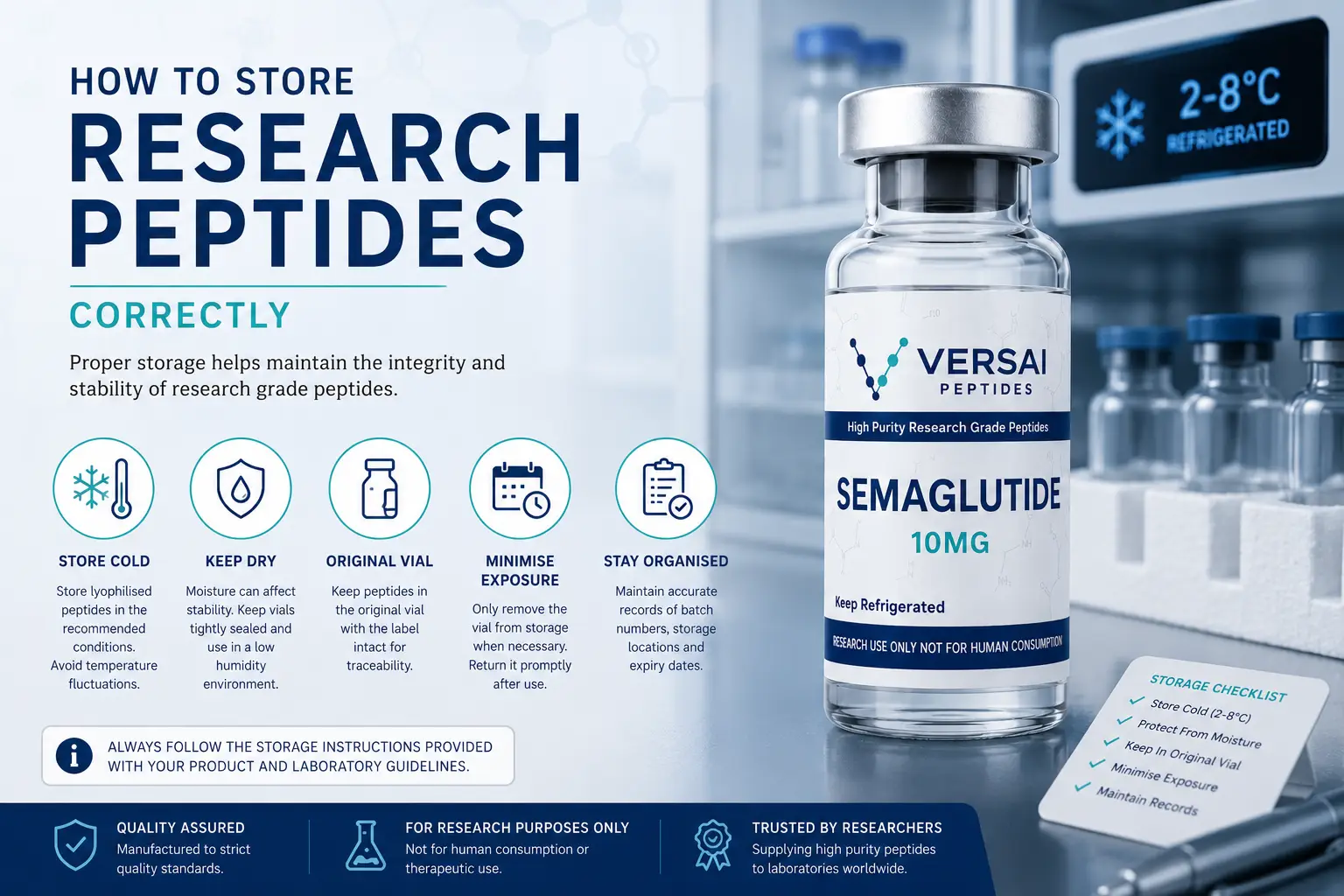
Packaging and Storage
After lyophilisation, peptides are packaged into laboratory vials designed to help protect the contents during transport and storage.
Packaging often includes:
- Product name
- Batch identification
- Quantity
- Laboratory-use labelling
- Storage recommendations
Proper packaging supports traceability and helps laboratories identify materials accurately.
Why Manufacturing Quality Matters
Research often depends on reproducibility. Consistent manufacturing practices can help laboratories obtain materials that are appropriate for controlled scientific investigations.
When selecting a supplier, researchers may consider factors such as:
- Manufacturing consistency
- Clear product labelling
- Appropriate packaging
- Transparent product information
- Reliable customer support
These factors can contribute to confidence in laboratory procurement.
Understanding Peptide Purity
Purity describes how much of the final preparation consists of the intended peptide relative to other compounds that may remain after synthesis.
Purification processes aim to reduce unwanted materials while retaining the target peptide.
Researchers should always review the documentation provided by the supplier and follow appropriate laboratory procedures when evaluating materials.
The Importance of Batch Consistency
Scientific studies often rely on repeatable methods.
Consistent manufacturing practices can help reduce variability between production batches, supporting reproducibility in laboratory work.
While manufacturing controls can improve consistency, researchers should evaluate products based on their own quality requirements and experimental protocols.
Selecting a Research Peptide Supplier
Choosing a supplier involves more than comparing prices.
Researchers may wish to consider:
Product Information
Clear descriptions and specifications help laboratories identify suitable materials.
Packaging Standards
Secure packaging helps protect products during shipping.
Customer Service
Responsive support can assist with product-related questions and order enquiries.
Transparency
Suppliers should clearly explain the intended use of their products and provide accurate product information.
Frequently Asked Questions
What is Solid Phase Peptide Synthesis (SPPS)?
SPPS is a widely used chemical manufacturing method in which amino acids are added sequentially to create a defined peptide sequence.
Why are research peptides purified?
Purification helps remove unwanted by-products and incomplete peptide chains generated during synthesis.
What is lyophilisation?
Lyophilisation, or freeze-drying, removes water from a peptide solution under controlled conditions to produce a dry powder suitable for laboratory storage.
Why is peptide quality important?
Consistent manufacturing and appropriate quality control can help researchers obtain materials suitable for laboratory investigations.
Are research peptides intended for medical use?
No. Products supplied by Versai Biotech Ltd are intended for laboratory research purposes only and are not intended for human consumption or medical use.
Why Choose Versai Biotech Ltd?
Versai Biotech Ltd supplies research peptides for scientific and laboratory research.
We are committed to:
- Professional customer service
- Secure UK shipping
- Clear product information
- Transparent product labelling
- Reliable packaging
- Supporting researchers with high-quality laboratory products
All products are supplied strictly for laboratory research purposes only.
Conclusion
The manufacture of research peptides involves multiple carefully controlled stages, including peptide synthesis, purification, analytical testing, lyophilisation, and packaging.
Understanding these processes helps researchers appreciate the importance of manufacturing quality and informed supplier selection.
At Versai Biotech Ltd, we are committed to supplying research peptides intended for laboratory research while maintaining clear communication about product quality, packaging, and intended use.